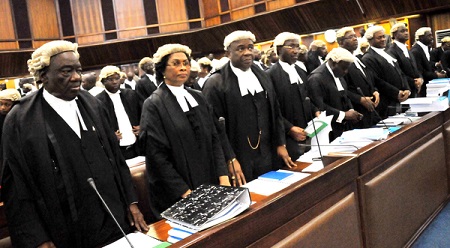
On the eve of his decision to nominate Oliver Wendell Holmes as Associate Justice of the United States Supreme Court in 1902, President Theodore Roosevelt wrote to his friend, Senator Henry Cabot Lodge, that “the ablest lawyers are men whose past has naturally brought them into close relationship with the wealthiest and the most powerful.” What he left unsaid was that they are also men who profit from such relationships. Profiting from the deployment of unrivalled skill and intellect in the service of the wealthiest and the most powerful is not criminal but it is possible to achieve material wealth and end up craven or hollow.
Continuing his letter to Senator Cabot Lodge, President Roosevelt also expressed his joy and gladness at being able to find the great lawyer who “has been able to preserve his aloofness of mind so as to keep his broad humanity of feeling and his sympathy for the class from which he has not drawn his clients.”
When Holmes turned 90 in 1931, Benjamin Cardozo, no slouch in the pantheon of great judges himself, described Holmes as “the great overlord of the law and its philosophy.” Posterity would prove a lot less generous.
At the fortieth anniversary of Holmes’ death in 1977, his literary executor, the Harvard Law School, declined to publish the essay of Yale Law School professor and his authorized biographer, Grant Gilmore, because it was explosively critical. Gilmore regarded Holmes as “the only man of the law who ever became a folk hero”, but concluded that “the real Holmes was savage, harsh, and cruel, a bitter and lifelong pessimist who saw in the course of human life nothing but a continuing struggle in which the rich and powerful impose their will on the poor and weak.” Gilmore died in 1982, his work on Holmes unpublished.
Sheldon Novick, author of arguably the most authoritative published biography of Holmes, answered “no” to the question “would you have wanted Justice Holmes as a friend?” University of Chicago law Professor, Albert Alschuler, concluded that Holmes’ was a life of “Law Without Values.”
The greatest lawyers somehow manage to both profit from their association with the great and the good and simultaneously make a lasting contribution to the lives of the class from which they have not drawn their clients. Former US Chief Justice, William Rhenquist, had an appellation for this genre. He called them “the Lawyer-Statesman.” Former Dean of the Yale Law School, Anthony Kronman, writes of such lawyers that they care “about the public good and is prepared to sacrifice his own well-being for it, unlike those who use the law merely to advance their private end. He is distinguished too by his special talent for discovering where the public good lies and for fashioning those arrangements needed to secure it.”
Hard won forensic battles will always be acknowledged in the law reports but that is for interested lawyers only. They’re getting fewer. Ten days before he died of cancer in January 2001, George Carman Q.C., arguably the most celebrated English Barrister of his generation, requested his son, Dominic, to undertake a post-humous biography. Published in 2002, the son’s No Ordinary Man: A Life of George Carman, QC, painted the picture of a sad, insecure, violent man who “was so intelligent and articulate and yet so brutal and barbaric.”
The material appurtenances of vocational success will be easily visible to those who care but those are irrelevant as measures of greatness. It is possible to make money and win cases while hollowing out the law and making life impossible for ordinary people. In Nigeria today, that species can be found in abundance. Here, comparisons with leading lives in the law and justice from other African countries may be useful.
Nelson Mandela needs no introduction. But Bram Fischer does. He was lead counsel to Mandela at the Rivonia trial. Scion of a most privileged Boer family, Bram chose to deploy himself in the transformation of South Africa. Born in 1908, his father was the Judge-President of the Orange Free State, and his grand-father was the Prime Minister of the Orange River Colony. As South Africa’s leading Silk, Bram had nothing to gain from placing his considerable skills, intellect, and pedigree at the disposal of a struggle that offered him what appeared to be no direct benefits. For this he was to pay the ultimate price.
Persecuted and jailed by the Apartheid regime, Bram Fischer died in 1975 of cancer diagnosed in prison. He was released on 10 March to die on 8 May 1975. Nelson Mandela considered him the greatest South African. At the first Bram Fischer Memorial lecture in June 1995, Mandela explained why: “Bram was a courageous man who followed the most difficult course any person could choose to follow. He challenged his own people because he felt that what they were doing was morally wrong. As an Afrikaner whose conscience forced him to reject his own heritage and be ostracised by his own people, he showed a level of courage and sacrifice that was in a class by itself. I fought only against injustice not against my own people.”
Maison des Avocats (Bar centre), which houses Senegal’s Bar in Dakar, was the only home of Dr. Lamine Guèye, Senegal’s first lawyer, who died in 1968. Admitted to the French Bar in 1921, Guèye mentored Senegal’s independence leaders, including Leopold Senghor whom he introduced into politics. An early anti-fascist and advocate of the human rights of women, Guèye emerged in 1937 as leader of the French section of Workers International. La loi Lamine Guèye which granted the citizenship of France to all inhabitants of France’s overseas colonies on 7 May 1946, memorializes his egalitarian advocacy. Guèye was the President of Senegal’s legislature and is widely credited with laying the foundations of that country’s inclusive politics.
Centenarian, Abdoulaye Wade, is Senegal’s oldest living president. He is also Senegal’s senior-most lawyer and law Professor. Wade was founding dean of the faculty of law and economic sciences at the Université Cheikh Anta Diop in Dakar. Professor Wade was also an outstanding advocate whose distinguished list of clients included Ahmed Ben Bella in Tunisia, Houari Boumediene in Algeria, Omar Bongo in Gabon, and the French hydro-carbons behemoth, Elf Aquitaine. Back home, Professor Wade was also an equally energetic advocate of open government and alternance in a country that was until the tail end of the last millennium a de facto single party State. Even as a mere professor, Wade’s modest home in Dakar was a city landmark. It remains so.
Moleleki Didwell Mokama was Botswana’s first indigenous lawyer and first Ambassador to anywhere. At the independence in 1966, he was designated Botswana’s High Commissioner to Britain, with concurrent accreditation to all the then six member States of what later became the European Economic Community. He was also Botswana’s first indigenous Attorney-General and first Chief Justice. Like Nelson Mandela, Mokama was a product of Fort Hare University in South Africa.
At the Inns of Court in London, Mokama was a pupil of legendary trial lawyer, Dingle Foot Q.C. In his professional life, he was for a long time on the Board of the solid-minerals conglomerate, De Beers. Botswana’s tradition of rigorous governance of its solid minerals earnings owes a lot to his temperance, restraint, and institutionalized legality. As Attorney-General, Mokama singularly persuaded the government of Botswana, then under pressure from Apartheid South Africa, against imposing emergency rule. At considerable risk as Chief Justice, Mokama ensured that the ruling party did not alter the law to overturn unpopular judgments of a fragile judicial system. When he died in 1997, the country paused in unison to pay its respects to a son who lived to make his people better.
As different as they were, these five men were all pioneering lawyer-statesmen for whom the law provided an Archimedean point to transform for the better the world and institutions that they met. At the price of considerable personal discomfort, and through commitment to goals greater than mere legalism or the winning of debating points in law’s name, they chose to transcend the law by transforming the mechanisms and institutions that make it. Millions of their compatriots are better for their having been lawyers. Where can we find their ilk in Nigeria?
A lawyer and a teacher, Odinkalu can be reached at chidi.odinkalu@tufts.edu