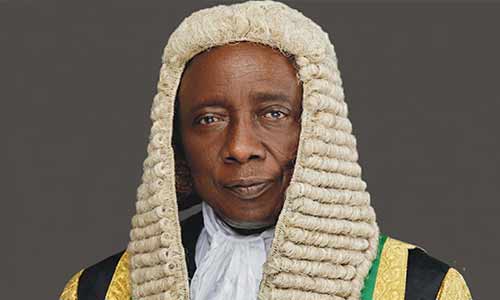
Courts are creatures of law. Everything about them, including what they can do (jurisdiction) and how they can do it (procedure) is prescribed and regulated by law. As such, it should never be said that what a court or judge cannot do does not exist. In Nigeria, however, some judges seem to glory in a reputation for “anything goes”. This roll of the disreputable judge has a new member. His name is Isa Hamma Dashen.
Dashen, the community into which young Isa Hamma was born on 4 April 1962, is located in Jada Local Government Area of Adamawa State in north-east Nigeria.
Basic education for him began at the Dashen Primary School.
In 1975, Isa Hamma proceeded to the Government Secondary School in Ganye for his high school. Following remedial studies at the College of Preliminary Studies first in Yola (capital of Adamawa State) and then in Zaria, Kaduna State, he gained admission into the Ahmadu Bello University (ABU) in 1983 to study law.
Following graduation in 1986, Isa Hamma proceeded to the Nigerian Law School in Lagos. A mishap in the Bar Finals delayed his admission to the Nigerian Bar in 1987. Following a re-sit, he eventually enrolled as a lawyer in Nigeria in March 1988.
Isa Hamma’s entire working life has been spent in the public service. Some will suggest that this equips him to know how to bend to the winds of power.
For his National Youth Service, Isa Dashen was posted to the Ibadan Municipal Council in Oyo State. Upon conclusion of that programme, he returned to his home state where he began his career in the court system. In 1989, he joined the registry staff of the judiciary in Adamawa State. Three years later, in 1992, he became a Magistrate. By September 1998, he was a Chief Magistrate.
On 2 December 2015, after 23 years as a Magistrate, Muhammadu Buhari appointed Isa Hamma Dashen as a judge of the Federal High Court.
In the period of over ten years that he has worked as a judge of the Federal High Court, Isa Hamma Dashen has traversed much of the country and dealt with an impressive variety of cases. Few would have made him as infamous as his most recent.
On 10 November 2025, one Takori Mohammed Sani, a lawyer who claimed to be the “Pro-tem National Secretary” of the Nigeria Democratic Congress (NDC) led three other claimants, including Abdulmumin Ohiare Abdulsalami and Pius Ugboja, Chairman and Secretary respectively of the party in Kogi State, to sue the Independent National Electoral Commission (INEC) at the Federal High Court in Lokoja, capital of Kogi State. They claimed that they began the process of registration of the party in 2017 and that, although they had fulfilled all the conditions prescribed, the INEC refused them registration. They, therefore, asked the court to order the INEC to register them.
When it notified the applicants on 19 September 2025 of its decision to decline their application for registration as a party, INEC claimed that it was because their logo resembled that of the ruling All Progressives Congress (APC), an existing and lawful political party. The political association offered to remedy this but received no response from the INEC.
In opposition to the claim of the applicants, INEC – in the words of the court – “introduced a new and inconsistent basis for the refusal of registration, namely, a purported similarity between the plaintiffs’ logo and that of a different political association referred to as Peace Movement Party (PMP), which was admittedly never communicated to the Plaintiffs prior to litigation.”
On Human Rights Day (10 December) in 2025, Isa Dashen handed down his judgment. He found as a fact that the political association had fulfilled all the conditions needed for its recognition as a political party and that INEC did not have the discretion to deny them recognition as such. In the circumstance, he ordered INEC to register the party “forthwith”.
Isa Dashen made three additional findings which would prove significant in the light of what transpired subsequently. First, he found that there was no evidence “showing that this PMP ground was ever communicated to the Plaintiffs at any time.”
Second, he described the effort by INEC to bring the PMP into the proceedings as both “belated” and an “impermissible afterthought”.
Third, Isa Dashen held that “with respect to logo similarity, Section 222(e) of the Constitution does not empower INEC to reject a logo merely because it visually resembles that of an existing party.”
With even greater force, it surely cannot be, therefore, that INEC can refuse to recognize a party based on claims that its logo resembles that of a non-existent party. But that is exactly the kind of somersault that Isa Dashen managed to contrive.
Nearly five months after this judgment, on 5 May 2026, one Emmanuel Uzowuru, who described himself as “Pro-tem National Legal Adviser” of the PMP, filed an application in the original suit asking the court to extend the time within which he could move it to overturn (vacate) its earlier judgment of 10 December 2025. By the same application, Mr. Uzowuru asked Isa Dashen to vacate his judgment of 10 December 2025 because the logo of the NDC resembled that of the PMP.
Mind you, unlike the NDC or APC, the PMP is not a registered political party. Isa Dashen had already ruled in December 2025 that the issue of logo was not a basis for denying registration to a political party and that INEC had never at any point in the process brought the issue of PMP to the attention of the NDC. Moreover, Mr. Uzowuru was not a party to the case or judgment he wanted overturned and he was not seeking to be joined even at that late stage.
In other words, Mr. Uzowuru asked Isa Dashen to make a mockery of himself and his court. He must have been overwhelmed when the judge ruled on 26 June to grant his outlandish desire, and then some.
The ruling is notable, however, for what it did not do or say.
Isa Hamma did not join the Mr. Uzowuru as a party to the case. He did not consider the application by him to extend the time within which he could have applied to set aside the judgment; and he did not consider or overrule his earlier findings that PMP was not an issue in the case before him.
In his haste to accomplish the kinds of things no court can do – unless it is corrupt – Isa Hamma Dashen proceeded to set aside his own judgment of 10 December 2025. He ordered the parties to “take all necessary and permissible procedural steps…. for the effectual determination of the substantive dispute.”
In saying so, Isa Dashen insinuated that there was a dispute between PMP, NDC, and INEC. This was precisely an issue that he had disposed of in the negative in his judgment of 2025. He could not re-open it and surely not at the instance of an applicant with no standing to do so.
It is not as if PMP was without options. It could have initiated a separate case. It could also have applied to the Court of Appeal as an affected party for permission to appeal against the judgment. It chose instead to make the kind of application that no one qualified as a judge can countenance and only a disreputable one can consider.
Columnist, Olu Fasan, accuses Isa Hamma Dashen of “judicial recklessness and vandalism.” I will go further to say that his ruling of 26 June 2026 is a perfect exhibit of “what a judge cannot do does not exist”. Whenever that can be said of a judgment, you can be certain that it is corrupt on the face of the record.
A lawyer and a teacher, Odinkalu can be reached at chidi.odinkalu@tufts.edu